
Compliance of Two-Thirds Gender Principle: An Assessment of Kenya’s Judiciary

Category: General
By: Leo Kipkogei Kemboi,
The Gender principle passed in the 2010 Constitution was an unintended consequence of underrepresentation of the Women gender consistently in all arms of government since independence. Article 27(8) requires the State shall take legislative and other measures to implement the principle that not more than two-thirds of the members of elective or appointive bodies shall be of the same gender. Judiciary is one of the arms of the government is obligated to comply with the two-thirds gender principle. The Judicial Service Commission (JSC) is required under Article 172(2)b of the Constitution of Kenya to promote gender equality. Section 3(j) of the Judicial Service Act requires the Judicial Service Commission and Judiciary to promote gender equity. Section 10(2) of the Third Schedule of the Judicial Service Act requires the Judicial Service Commission to take into account gender consideration in the recommendations of Candidates for Appointments .
Compared to other arms of government, the Judiciary has made significant strides in the implementation of two-thirds gender principle with the aspiration to make equal (50:50) . The JSC Service Charter Part II takes cognizance of the Constitutional and Legal obligations of the Commission in implementing the two-thirds gender principle . Another key policy document Sustaining Judiciary Transformation (SJT) 2017-2021 doesn’t mention strategies to be used in obtaining gender parity across all court levels . Judiciary has made more progress in the advancement of gender equity ever since the enactment of the new Constitution in 2010. They are more female judges at higher courts post-2010 .
From literature, evidence exists that women presence on the court is not an act of mere formality but brings forth benefits to society. Massie, Johnson, and Gubala (2002) find that the influence of female judicial officers to be more pronounced on issues that are of the utmost concern to women and the community in the United States Courts of Appeals . Johnson, Songer, and Jilani (2011) find that women Judicial officers vote more liberally on civil rights, equality, and private economic cases, and more conservatively on criminal cases in the Appeal Courts of Canada .
Another Jurist, Judge Vanessa Ruiz argues that women presence in the Judiciary is not only important for legitimacy, but women contribute to the quality of decision making and quality of justice itself by bringing women lived experiences to their judicial actions . Women lived experiences include complex family relationships, obligations, social and cultural impacts.
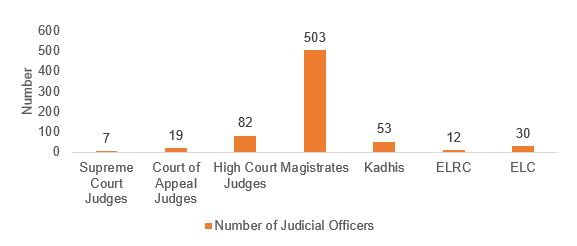
Kenya has 706 judicial officers equivalent to 1 judicial officer for every 69,000 Kenyans. The breakdown of the Court is shown in the chart below.
Chart: Number of Judicial Officers by Court
.JPG)
Source: Statistical Abstract 2020, SOJAR 2018/19
Magistrates and High Court judges comprise of 71% and 12% of the Court respectively. The judicial officers sitting on Supreme Court, Court of Appeal, Kadhis Court, Environment and Land Court, and Employment and Labour Relations Court comprise the rest 17% of all court.
Assessment of the Judiciary on the compliance of the two-thirds gender principle shows that the Court is largely compliant. The table below shows the breakdown of the gender composition by each level of the court.
Table 1: Gender Composition of Judicial Officers by Court
.JPG)

Source: Statistical Abstract 2020
Observations
- Looking at the gender composition of all levels Court, the judiciary has complied with the two-thirds gender principle with 332 women sitting on the Courts which is equivalent to 47%.
- Except for the Supreme court and the Kadhis Court, all other court levels have complied with Article 27(8) of the Constitution of Kenya.
- Kadhis courts have magistrates of one gender which is inconsistent with Article 27(8) of the Constitution of Kenya.
- The Magistrate court is the most compliant with two-thirds gender rule with 53% of women sitting on the Court than men.
- At the lowest court level –their gender parity. The gender parity is skewed in favour of male for higher and more specialised courts as much as they have met the two-thirds gender rule.
- Other latent/underlying issues/barriers have hindered percentage of female gender sitting at the court and they include: education, politics, culture, family obligations, etc
- Even though the Constitution requires at least one-third of either gender, the aspiration should be 50:50.
Conclusions
As a whole, Kenya’s Judiciary is largely compliant with the two-thirds gender principle as outlined in Article 27(8) of the Constitution of Kenya. However, specific courts which include the Supreme Court and the Kadhis that remain not compliant with gender principle. The gender parity is at lower courts. Gender parity at higher courts and specialized courts is skewed more towards the male gender. The Judicial Service Commission should be accountable for the failure to adhere to the two-thirds gender principle as an outline on Article 27(8) of the Constitution of Kenya. The Judicial Service Commission in its own volition should bring forward a plan towards a gender diverse court especially at the highest court levels where gender parity is skewed towards one gender. The Judicial Service Commission performance must be assessed on the basis of attainment of two-thirds gender principle in Judiciary.
Parliament should propose sanctions for lack of compliance across all three arms of the state and any other firm that relies on public coffers for direct budgetary support or debt guarantees. Parliament’s inaction on ensuring Article 27(8) could be largely explained by its poor performance on the two-thirds gender principle that even the Chief Justice advised the President to dissolve parliament in line with article 261(7) of the Constitution of Kenya, 2010 . Parliament immediately went Court and obtained orders barring dissolution of Parliament until the issues raised in the Petition are heard and determined.
End Notes
- “Judicial Service Act No. 1 of 2011.” kenyalaw.org. Published by the National Council for Law Reporting with the Authority of the Attorney-General, 2011. http://kenyalaw.org/kl/fileadmin/pdfdownloads/Acts/Judicial_Service_Act_2011.pdf
- Page 8, last Paragraph from “Transcript of Chief Justice Willy Mutunga Interview with Maya Gainer.” https://successfulsocieties.princeton.edu. Innovations for Successful Societies, October 8, 2015. https://successfulsocieties.princeton.edu/sites/successfulsocieties/files/interviews/transcripts/4091/B27_OGP_MG_%20Willy%20Mutunga_Final.pdf.
- “Judicial Service Commission Service Charter.” jsc.go.ke. The Judicial Service Commission, 2015. https://www.jsc.go.ke/wp-content/uploads/2020/04/JSC-CHARTER..pdf.
- “Sustaining Judiciary Transformation(SJT): A Service Delivery Agenda, 2017-2021.” jsc.go.ke, 2017. https://www.jsc.go.ke/wp-content/uploads/2020/04/JUDICIARY-STRATEGIC-BLUEPRINT-2017-2021.pdf.
- “Transcript of Chief Justice Willy Mutunga Interview with Maya Gainer.” https://successfulsocieties.princeton.edu. Innovations for Successful Societies, October 8, 2015. https://successfulsocieties.princeton.edu/sites/successfulsocieties/files/interviews/transcripts/4091/B27_OGP_MG_%20Willy%20Mutunga_Final.pdf.
- Massie, Tajuana D, Susan Johnson, and Sara Margaret Gubala. “The Impact of Gender and Race in the Decisions of Judges on the United States Courts of Appeals.” ResearchGate. , 2002. https://www.researchgate.net/publication/228432244_The_Impact_of_Gender_and_Race_in_the_Decisions_of_Judges_on_the_United_States_Courts_of_Appeals
- Johnson, Susan W., Donald R. Songer, and Nadia A. Jilani. “Judge Gender, Critical Mass, and Decision Making in the Appellate Courts of Canada.” Journal of Women, Politics & Policy 32, no. 3 (July 2011): 237–60. https://doi.org/10.1080/1554477x.2011.589293.
- Ruiz, Judge Vanessa. “The Role of Women Judges and a Gender Perspective in Ensuring Judicial Independence and Integrity.” Unodc.org, 2019. https://www.unodc.org/dohadeclaration/en/news/2019/01/the-role-of-women-judges-and-a-gender-perspective-in-ensuring-judicial-independence-and-integrity.html.
- KNBS, “Statistical Abstract 2020,” December 22, 2020,https://www.knbs.or.ke/?wpdmpro=statistical-abstract-2020
- The Judiciary of Kenya. “State of Judiciary and the Administration of Justice: 2018/19 Annual Report,” 2020. https://www.judiciary.go.ke/download/sojar-report/.
- Maraga, David. “Chief Justice’s Advice to the President pursuant to Article 261(7) of the Constitution,” September 21, 2020. http://kenyalaw.org/kenyalawblog/wp-content/uploads/2020/09/Copy-of-CJs-Advice-to-President.pdf.
- Bhalla, Nita. “Kenya High Court Suspends Move to Dissolve Parliament over Lack of Women.” reuters.com, September 25, 2020. https://www.reuters.com/article/us-kenya-women-politics-idUSKCN26F3OV.
More Blogs
Court adjournments and case burdens, and the implications for access to justice
Case Adjournments is one of the key issues that contributes to case backlogs because it reduces the efficiency of courts. An adjournment in a legal setting involves pausing or temporally stopping ongoing proceedings to be continued at a later time, date, or location. It may also indicate the end of the day’s proceedings. Parties involved […]
Potential Benefits and Risks of Inter-Sacco Lending Rate
Introduction In February 2023, the Kenyan government announced its intention to establish a framework that will enable Savings and Credit Cooperative Societies (SACCOs) to extend loans to each other. This inter-Sacco lending framework shall be set up by the Sacco Societies Regulatory Authority (SASRA) and was anticipated to be in effect from August 2023. This […]
Increasing Enrolment in Kenya’s Social Health Insurance: How Best It Can Be Done
While Kenya has long implemented the NHIF (National Hospital Insurance Fund) whose core mandate is to provide medical insurance coverage to all its members and their declared dependants and also to make medical care affordable, enrolment rates, particularly in the voluntary and informal sectors, remain low. Yet, NHIF is the most common type of health […]
Double Taxation Agreements: How they Work
Introduction According to the United Nations, Double Taxation Agreements (DTAs) are “bilateral agreements between two countries which allocate taxing rights over income between those two countries thereby preventing double taxation of income. The main objective of DTAs therefore, is to prevent and or eliminate avoidance and evasion of taxes on income and capital by both […]
Courts as Monopolies: What Does It Mean for Access to Justice?
Courts as Monopolies Access to justice is fundamental in any democratic society, ensuring individuals can pursue their legal rights and seek redress for grievances. However, when courts operate as monopolies, it can have implications for access to justice. Monopolies have exclusive control or dominance over a particular market or industry. Courts are monopolies because they […]
Compliance of Two-Thirds Gender Principle: An Assessment of Kenya’s Judiciary
| Post date: Mon, Feb 8, 2021 |
| Category: General |
| By: Leo Kipkogei Kemboi, |
The Gender principle passed in the 2010 Constitution was an unintended consequence of underrepresentation of the Women gender consistently in all arms of government since independence. Article 27(8) requires the State shall take legislative and other measures to implement the principle that not more than two-thirds of the members of elective or appointive bodies shall be of the same gender. Judiciary is one of the arms of the government is obligated to comply with the two-thirds gender principle. The Judicial Service Commission (JSC) is required under Article 172(2)b of the Constitution of Kenya to promote gender equality. Section 3(j) of the Judicial Service Act requires the Judicial Service Commission and Judiciary to promote gender equity. Section 10(2) of the Third Schedule of the Judicial Service Act requires the Judicial Service Commission to take into account gender consideration in the recommendations of Candidates for Appointments .
Compared to other arms of government, the Judiciary has made significant strides in the implementation of two-thirds gender principle with the aspiration to make equal (50:50) . The JSC Service Charter Part II takes cognizance of the Constitutional and Legal obligations of the Commission in implementing the two-thirds gender principle . Another key policy document Sustaining Judiciary Transformation (SJT) 2017-2021 doesn’t mention strategies to be used in obtaining gender parity across all court levels . Judiciary has made more progress in the advancement of gender equity ever since the enactment of the new Constitution in 2010. They are more female judges at higher courts post-2010 .
From literature, evidence exists that women presence on the court is not an act of mere formality but brings forth benefits to society. Massie, Johnson, and Gubala (2002) find that the influence of female judicial officers to be more pronounced on issues that are of the utmost concern to women and the community in the United States Courts of Appeals . Johnson, Songer, and Jilani (2011) find that women Judicial officers vote more liberally on civil rights, equality, and private economic cases, and more conservatively on criminal cases in the Appeal Courts of Canada .
Another Jurist, Judge Vanessa Ruiz argues that women presence in the Judiciary is not only important for legitimacy, but women contribute to the quality of decision making and quality of justice itself by bringing women lived experiences to their judicial actions . Women lived experiences include complex family relationships, obligations, social and cultural impacts.
Kenya has 706 judicial officers equivalent to 1 judicial officer for every 69,000 Kenyans. The breakdown of the Court is shown in the chart below.
Chart: Number of Judicial Officers by Court
Source: Statistical Abstract 2020, SOJAR 2018/19
Magistrates and High Court judges comprise of 71% and 12% of the Court respectively. The judicial officers sitting on Supreme Court, Court of Appeal, Kadhis Court, Environment and Land Court, and Employment and Labour Relations Court comprise the rest 17% of all court.
Assessment of the Judiciary on the compliance of the two-thirds gender principle shows that the Court is largely compliant. The table below shows the breakdown of the gender composition by each level of the court.
Table 1: Gender Composition of Judicial Officers by Court
Source: Statistical Abstract 2020
Observations
- Looking at the gender composition of all levels Court, the judiciary has complied with the two-thirds gender principle with 332 women sitting on the Courts which is equivalent to 47%.
- Except for the Supreme court and the Kadhis Court, all other court levels have complied with Article 27(8) of the Constitution of Kenya.
- Kadhis courts have magistrates of one gender which is inconsistent with Article 27(8) of the Constitution of Kenya.
- The Magistrate court is the most compliant with two-thirds gender rule with 53% of women sitting on the Court than men.
- At the lowest court level –their gender parity. The gender parity is skewed in favour of male for higher and more specialised courts as much as they have met the two-thirds gender rule.
- Other latent/underlying issues/barriers have hindered percentage of female gender sitting at the court and they include: education, politics, culture, family obligations, etc
- Even though the Constitution requires at least one-third of either gender, the aspiration should be 50:50.
Conclusions
As a whole, Kenya’s Judiciary is largely compliant with the two-thirds gender principle as outlined in Article 27(8) of the Constitution of Kenya. However, specific courts which include the Supreme Court and the Kadhis that remain not compliant with gender principle. The gender parity is at lower courts. Gender parity at higher courts and specialized courts is skewed more towards the male gender. The Judicial Service Commission should be accountable for the failure to adhere to the two-thirds gender principle as an outline on Article 27(8) of the Constitution of Kenya. The Judicial Service Commission in its own volition should bring forward a plan towards a gender diverse court especially at the highest court levels where gender parity is skewed towards one gender. The Judicial Service Commission performance must be assessed on the basis of attainment of two-thirds gender principle in Judiciary.
Parliament should propose sanctions for lack of compliance across all three arms of the state and any other firm that relies on public coffers for direct budgetary support or debt guarantees. Parliament’s inaction on ensuring Article 27(8) could be largely explained by its poor performance on the two-thirds gender principle that even the Chief Justice advised the President to dissolve parliament in line with article 261(7) of the Constitution of Kenya, 2010 . Parliament immediately went Court and obtained orders barring dissolution of Parliament until the issues raised in the Petition are heard and determined.
End Notes
- “Judicial Service Act No. 1 of 2011.” kenyalaw.org. Published by the National Council for Law Reporting with the Authority of the Attorney-General, 2011. http://kenyalaw.org/kl/fileadmin/pdfdownloads/Acts/Judicial_Service_Act_2011.pdf
- Page 8, last Paragraph from “Transcript of Chief Justice Willy Mutunga Interview with Maya Gainer.” https://successfulsocieties.princeton.edu. Innovations for Successful Societies, October 8, 2015. https://successfulsocieties.princeton.edu/sites/successfulsocieties/files/interviews/transcripts/4091/B27_OGP_MG_%20Willy%20Mutunga_Final.pdf.
- “Judicial Service Commission Service Charter.” jsc.go.ke. The Judicial Service Commission, 2015. https://www.jsc.go.ke/wp-content/uploads/2020/04/JSC-CHARTER..pdf.
- “Sustaining Judiciary Transformation(SJT): A Service Delivery Agenda, 2017-2021.” jsc.go.ke, 2017. https://www.jsc.go.ke/wp-content/uploads/2020/04/JUDICIARY-STRATEGIC-BLUEPRINT-2017-2021.pdf.
- “Transcript of Chief Justice Willy Mutunga Interview with Maya Gainer.” https://successfulsocieties.princeton.edu. Innovations for Successful Societies, October 8, 2015. https://successfulsocieties.princeton.edu/sites/successfulsocieties/files/interviews/transcripts/4091/B27_OGP_MG_%20Willy%20Mutunga_Final.pdf.
- Massie, Tajuana D, Susan Johnson, and Sara Margaret Gubala. “The Impact of Gender and Race in the Decisions of Judges on the United States Courts of Appeals.” ResearchGate. , 2002. https://www.researchgate.net/publication/228432244_The_Impact_of_Gender_and_Race_in_the_Decisions_of_Judges_on_the_United_States_Courts_of_Appeals
- Johnson, Susan W., Donald R. Songer, and Nadia A. Jilani. “Judge Gender, Critical Mass, and Decision Making in the Appellate Courts of Canada.” Journal of Women, Politics & Policy 32, no. 3 (July 2011): 237–60. https://doi.org/10.1080/1554477x.2011.589293.
- Ruiz, Judge Vanessa. “The Role of Women Judges and a Gender Perspective in Ensuring Judicial Independence and Integrity.” Unodc.org, 2019. https://www.unodc.org/dohadeclaration/en/news/2019/01/the-role-of-women-judges-and-a-gender-perspective-in-ensuring-judicial-independence-and-integrity.html.
- KNBS, “Statistical Abstract 2020,” December 22, 2020,https://www.knbs.or.ke/?wpdmpro=statistical-abstract-2020
- The Judiciary of Kenya. “State of Judiciary and the Administration of Justice: 2018/19 Annual Report,” 2020. https://www.judiciary.go.ke/download/sojar-report/.
- Maraga, David. “Chief Justice’s Advice to the President pursuant to Article 261(7) of the Constitution,” September 21, 2020. http://kenyalaw.org/kenyalawblog/wp-content/uploads/2020/09/Copy-of-CJs-Advice-to-President.pdf.
- Bhalla, Nita. “Kenya High Court Suspends Move to Dissolve Parliament over Lack of Women.” reuters.com, September 25, 2020. https://www.reuters.com/article/us-kenya-women-politics-idUSKCN26F3OV.
More Blogs
Court adjournments and case burdens, and the implications for access to justice
Case Adjournments is one of the key issues that contributes to case backlogs because it reduces the efficiency of courts. An adjournment in a legal setting involves pausing or temporally stopping ongoing proceedings to be continued at a later time, date, or location. It may also indicate the end of the day’s proceedings. Parties involved […]
Potential Benefits and Risks of Inter-Sacco Lending Rate
Introduction In February 2023, the Kenyan government announced its intention to establish a framework that will enable Savings and Credit Cooperative Societies (SACCOs) to extend loans to each other. This inter-Sacco lending framework shall be set up by the Sacco Societies Regulatory Authority (SASRA) and was anticipated to be in effect from August 2023. This […]
Increasing Enrolment in Kenya’s Social Health Insurance: How Best It Can Be Done
While Kenya has long implemented the NHIF (National Hospital Insurance Fund) whose core mandate is to provide medical insurance coverage to all its members and their declared dependants and also to make medical care affordable, enrolment rates, particularly in the voluntary and informal sectors, remain low. Yet, NHIF is the most common type of health […]
Double Taxation Agreements: How they Work
Introduction According to the United Nations, Double Taxation Agreements (DTAs) are “bilateral agreements between two countries which allocate taxing rights over income between those two countries thereby preventing double taxation of income. The main objective of DTAs therefore, is to prevent and or eliminate avoidance and evasion of taxes on income and capital by both […]
Courts as Monopolies: What Does It Mean for Access to Justice?
Courts as Monopolies Access to justice is fundamental in any democratic society, ensuring individuals can pursue their legal rights and seek redress for grievances. However, when courts operate as monopolies, it can have implications for access to justice. Monopolies have exclusive control or dominance over a particular market or industry. Courts are monopolies because they […]