
Major causes of morbidity in Kenya

Major causes of morbidity in Kenya
| Post date: Mon, Oct 1, 2018 | | Category: Health | |
In this week’s number we examine the distribution of diseases in Kenya by identifying diseases that are frequently reported by Kenyans. Knowledge of the disease prevalence is not only important for identifying of the relative risk levels among the population, it is also key in enhancing effectiveness of policy interventions.
More Kenyans still suffer from malaria more than any other disease, with atleast 37 patients in every 100 reporting to have suffered from the disease. Malaria is followed by Flu with a rate of 16 patients in every 100. In the third place is headache with a rate of 8% of the reported individuals.
Percentage Distribution of the Population that reported Being Sick/Injured by Type of Sickness/Injury, 2015/16
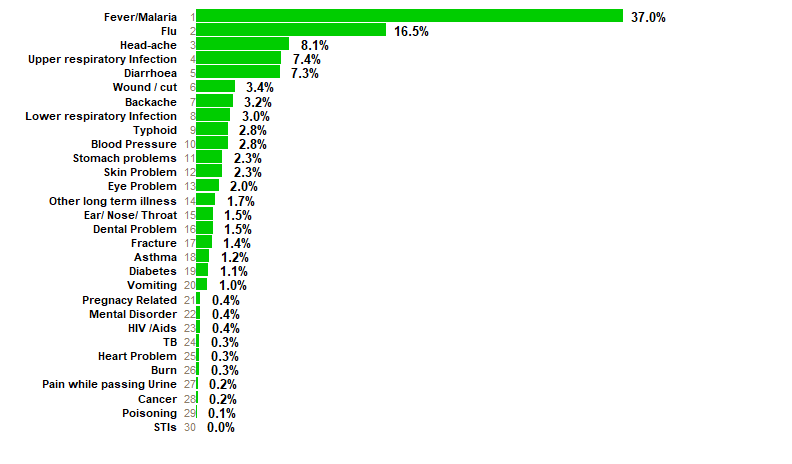
Source: Kenya Integrated Household Budget Survey, 2015/16
Further, as it is revealed in the above chart, population suffering from upper and lower respiration is significant at 7.4 % and 3% respectively. On the other hand, patients reported to be suffering from diseases such as burns, pain while passing urine, cancer, poisoning and STIs is less than 1% of all the patients.
The deduction from the above chart is that the likelihood of a Kenya Kenyan suffering from Malaria is the highest than any other disease, it is followed by Flu and headache. It is however lowest with regards to poisoning and STIs diseases. For instance, a Kenyan is 8 times more likely to suffer from malaria compared to headache, and more than 30 times more likely to suffer from Malaria than diabetes.
Number of the week: 37%: Majority of the diseases in Kenya are Non Communicable and Malaria is the most prevalent.
- The leading disease in Kenya remains to be malaria with a morbidity rate of 37%.
- Influenza makes approximately a quarter of the reported disease cases, thus ranking second.
- The most common Non-Communicable diseases reported in Kenya include Headache at 8.1%, wound/cut (3.4%) and backache (3.2%).
- Upper and Lower respiratory infections also comprise a significant share of the communicable diseases that are reported in Kenya.
- On the other hand report rates for Heart problem, Burn, Pain while passing urine, cancer, and Poisoning, categorized as Non Communicable diseases, are lower than 1% of all the diseases cases thus revealing that they are not the main disease burden.
Conclusion
Policy intervention focusing on diseases such as malaria and influenza are key in order to reduce the disease burden.
More Number of the Week
Kenya’s comparison of Out of pocket expenditure on Health with its peers
In the advent of increased Non-Communicable Diseases such as cancer that require long time treatment, reduction of the Out-of-pocket payments is key in sustaining affordability and access to health care services. These can be achieved through increased insurance both by the government and the private sector.
Outstanding Stock of Treasury Bonds by Holders
Treasury bonds are a secure, medium- to long-term investment tools that typically offer periodic interest payments semiannually throughout the bond’s life. The Central Bank auctions Treasury bonds on a monthly basis, but offers a variety of bonds throughout the year, so prospective investors should regularly check for upcoming auctions. Outstanding Treasury Bonds increased by 11.2 per cent to Ksh 1,152,041 million in June 2016 from Ksh 1,035,662 million in June 2015.
Outstanding Stock of Treasury Bills by Holders
In June 2016 compared to June 2015, the stock of Treasury bills increased by 84.4 per cent to Ksh 588,088 million from Ksh 318,929 million while the proportion held by commercial banks increased by 67.4 per cent to Ksh 361,859 million from Ksh 217,742 million. In the same period, holdings by pension fund institutions increased to 20.1 per cent from 12.8 per cent while proportion held by insurance companies decreased to 3.1 per cent from 6.5 per cent.
Outstanding Stock of Treasury Bills and Bonds by Holders
The medium term debt strategy for the financial year 2016/17 emphasized on the need to develop the domestic market by increasing the issuance of Treasury bonds over the medium term. The strategy targeted a mix of 60 percent and 40 per cent for external and domestic financing, respectively.
Trends in Kenya’s Total Domestic Public Debt Stock from 1999 – 2018 (In nominal terms)
Trends in Kenya’s Total Domestic Public Debt Stock from 1999 – 2018 (In nominal terms) Source: Central Bank of Kenya The number of the Week: 2.1, this is the factor by which domestic debt has grown in the last five years. Domestic debt has nearly doubled in the last five years (2013-2018) Between 1999 and […]